Wednesday, October 23, 2013

Killing our Darlings


Since I know you'll all be yearning for our usual meeting come Thursday afternoon, here's something to hold you over till after the break. A cast of fresh-faced stars are taking on Burroughs and the murderous primal scenes of mid-century beat culture! No less than Harry Potter will be playing Allen Ginsberg in this period piece, "Kill Your Darlings." If it opens up at a theater in the Twin Cities, we can consider coordinating an extracurricular excursion!

Sunday, October 20, 2013

The Bell Jar Continues and Concludes


Cold-and-hotties, get your closing questions and comments on The Bell Jar up here by Tuesday at noon, or attach them to the previous post. You should also check out Adlai Stevenson's commencement address to Sylvia Plath's graduating class at Smith College in 1955. Finally, take a look-see at an actual goggle-eyed headline from Plath's Smith days.

And since this next meeting is our last before the modest October break, here are a couple of relevant blogs to keep your interest piqued about our pet themes of gender, sexuality, and cold war.

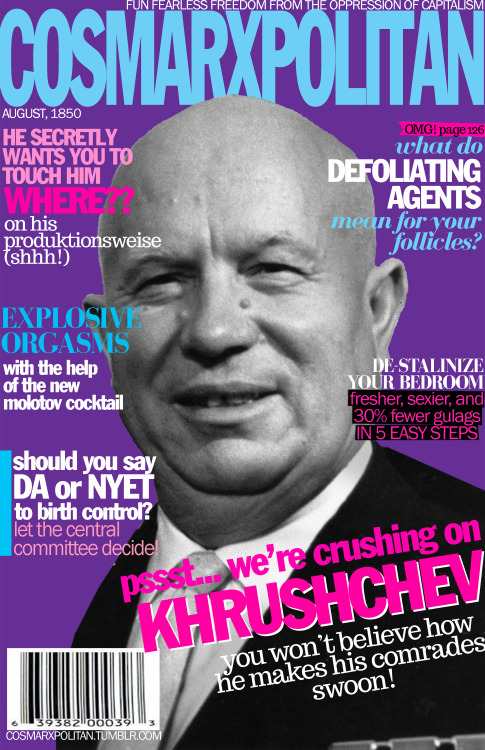
Bolshevik Mean Girls by blogger "It's Raining Mensheviks"and the classic Cosmarxpolitan . Enjoy!


Sunday, October 13, 2013

Shrouded in Mystery and Trapped under Glass with Betty Friedan and Sylvia Plath

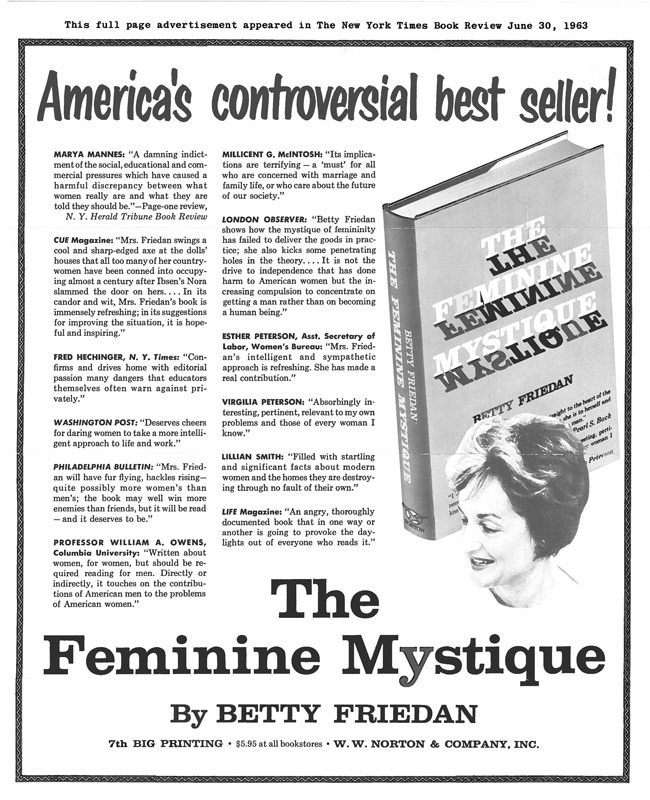
Post your comments below for Betty Friedan's Feminine Mystique and Sylvia Plath's Bell Jar. The latter text seems to trap its motifs under glass, so that they swirl around inside with suffocating intensity. Try to catch some salient images by extracting a particular passage for us to close-read in Tuesday's class.  I also strongly urge you to consider the points of contact between The Bell Jar and "Elizabeth Arden," especially with respect to the narrator's direct call out to a displaced reader. Could Esther Greenwood be that "you" whom she summons? Ethel Rosenberg perhaps?

Tuesday, October 8, 2013

Out of this World and into the Kitchen!

On the docket for our next class is a strange and sundry blend of topics and texts to cover. We will wrap up our section on alterity and masculinity with a presentation by Taylor on sci-fi films in cold war America. Please take this opportunity to synthesize the previous material, especially Sinyavsky and Burroughs, and stick it in your mind's eye as we watch Dr. Strangelove down the road apiece. Although its genre is more accurately a political satire, you'll find Kubrick's film nonetheless forces us to think about the surreal scenarios and attendant anxieties (about gender!) engendered by scientific knowledge in a nuclear age.

So strange is this vision of the technological future for housework in postwar America, as in this 1952 print ad for the Hotpoint electric range, it shouldcause us to make connections between science/sci-fi, and the cold war family!


While all that simmers, make sure your discussion question for Thursday deals directly with the pieces on the calendar for this class, on which Eden will also be presenting: the Kitchen Debate and two texts by socialist authors writing about the so-called women's question from the point of view of women themselves. In fact, as Hannah pointed out, this is the first time women have spoken for themselves on our syllabus, and we should interrogate that detail from a metacurricular angle: why is that so? How might we explain such an omission according to larger cultural logics? More pointedly, how does the Kitchen Debate instantiate such a sexist oversight?  

Sunday, October 6, 2013

Aliens, Art and Devices, Oh My! Making the Family Strange with Shklovsky and Sinyavsky

We're switching sides back to the Soviet Union for the next class, and splitting historical time down the middle again--as we did with Mayakovsky and Yevtushenko, now with Victor Shklovsky (1917/1925) and Andrei Siniavsky (ca. 1957).  As you may have surmised, the revolutionary avant-garde during Lenin's leadership found "comrades in posterity" during the cultural Thaw of the post-Stalin period. The critical continuities between "Art as Device" and "Pkhentz" will be immediately obvious to you, I'm sure. So please read the works on their own terms and in conversation with one another and the surrounding culture of the Cold War. Consider the following questions:
- What does Shklovsky define as the purpose of art and the task of the artist? Against what extant definitions is he working?
- How is art a device? What does it do and how?
- Is “Pkhentz” an allegory? Of what?
- What is the role of reading, writing and words in “Pkhentz”? Mark all the places texts appear in the story.
- How might we compare the description and function of the sexual grotesque in Sinyavsky’s and Baldwin’s stories?
-Finally, what are the stakes of "Pkhentz"'s taking an estranged or "defamiliarized" approach to art at that time? I suggest you think not only of Shklovsky's Russian notion of defamiliarization, but of the English etymology of this word. How have our texts made the family strange so far, and how does Cold War culture East and West try to make it automatic or familiar to the point of critical impenetrability?

Andrei Sinyavsky AKA Abram Tertz, post-GULAG.

Thursday, October 3, 2013

Flipping out, going mad, and meditating in the midst of Mutually Assured Destruction: Mad Men and Frank O'Hara

Our talk on Tuesday about hipster psychology as a response to the sustained crisis of the cold war primes us for the first and last episodes of the contemporary TV drama, Mad Men.


Please be sure to read the poems by Frank O'Hara that provide the season its framing metaphor, while also connecting us to our Russian hipsters by claiming a common ancestor in Vladimir Mayakovsky. Lenny Bruce gave us the set up for the Cuban Missile Crisis last time, so let his line We're all gonna die! hang over your head while you're watching, too.

Sunday, September 29, 2013

Hipsters, Part Two: The American Beatnik and Other Cool Cats

Lenny Bruce, raising his own eyebrow,
no doubt in a call-and-response
routine with the many he raised...
On the heels of Thursday's discussion about the Soviet Stilyaga's blue suede shoes, we hop over the ocean this Tuesday to meet his American counterpart in hip--the beatnik, jazz man, and the other faces in the crowd of cool cats who congregate in the seedier sections of major cities, like New York's East Village and San Francisco's North Beach. As you read Norman Mailer's seminal essay about hipster psychology, race, and the atomic age--a piece at once perspicacious and highly problematic--think back to our previous readings, and the ways they dealt differently with many of the same themes. Likewise for Lenny Bruce, who needs no introduction other than a name before he starts 'talking dirty and influencing you,' to paraphrase the title of one of his books.

For those of you who have watched Mad Men before Thursday's class, you may recognize Bruce as a smaller point of inspiration (beside Rat Packer Joey Bishop) for the show's Jewish comedian Jimmy Barrett. I mention this, and footnote Mailer's own downplayed Jewish background, because Jewish identity and Anti-Semitism are major if mostly unarticulated questions of the Cold War in the US and USSR. I encourage you to start thinking more systematically in this direction, perhaps starting with your discussion questions.